

LOTO guide for occupational safety specialists
This practical guide supports a systematic approach to hazardous energy control. It helps bring equipment details, energy sources, isolation points and employee responsibilities together in a coherent, functioning LOTOTO system.
The guide provides a practical foundation for workplace improvements and helps occupational safety specialists communicate with production, maintenance teams and contractors.

What will you find in this guide?
- when to apply LOTOTO and which mistakes to avoid;
- how to identify all types of hazardous energy;
- what an effective equipment-specific procedure and isolation point system look like;
- a 12-step LOTOTO sequence with practical explanations;
- a self-check questionnaire to help review the maturity of your LOTOTO programme.
LOTOTO principles — more than a padlock on a switch
Lockout / Tagout / Tryout is intended to prevent unexpected energisation while workers clean, repair, adjust or maintain equipment.
LOTO equipment
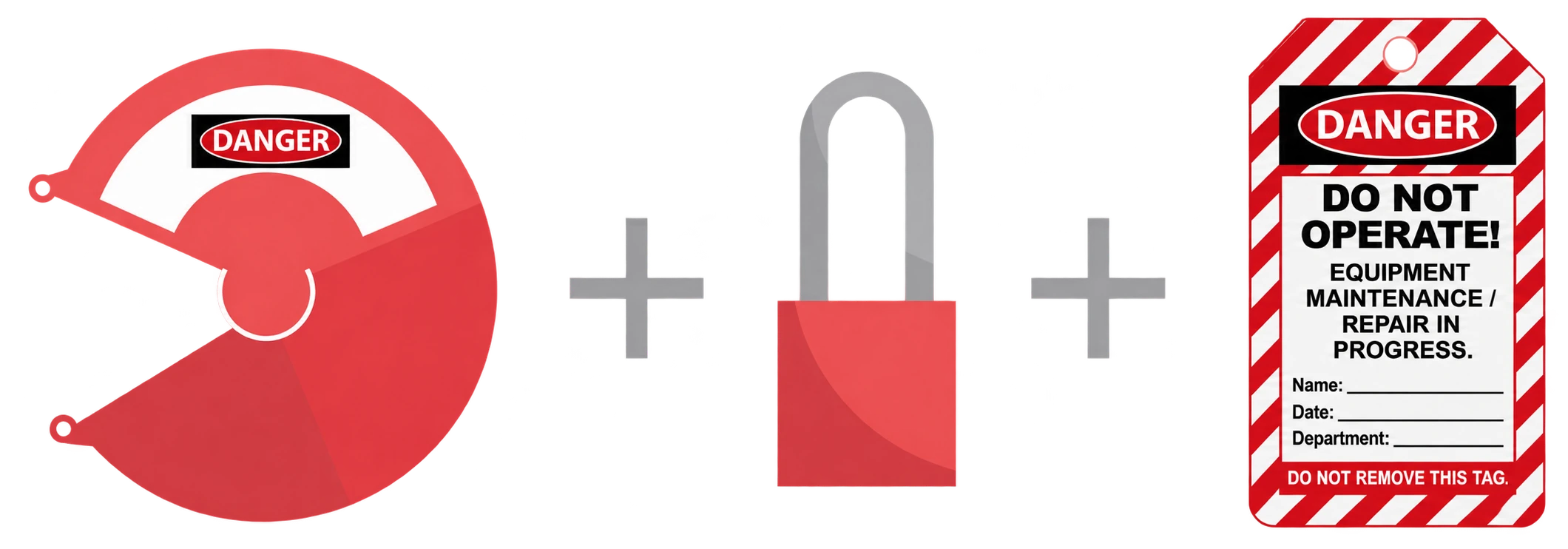
A traditional Lockout/Tagout (LOTO) system uses three principal items:
- a lockout device
- a padlock
- an identification tag
What is LOTOTO?
The additional “To” stands for “Tryout” (verification).
The term LOTOTO places additional emphasis on “Tryout” — verification that isolation is effective before work begins. Verification is also part of a LOTO procedure: confirm that the correct equipment has been isolated and that all energy sources relevant to the task have been controlled.
Good practice is to follow the LOTOTO: Lockout – Tagout – Tryout sequence consistently: isolate and lock out the energy sources, release or control stored energy, and carry out “Tryout” verification. Follow the equipment-specific procedure and use appropriate verification methods before anyone enters the danger zone.
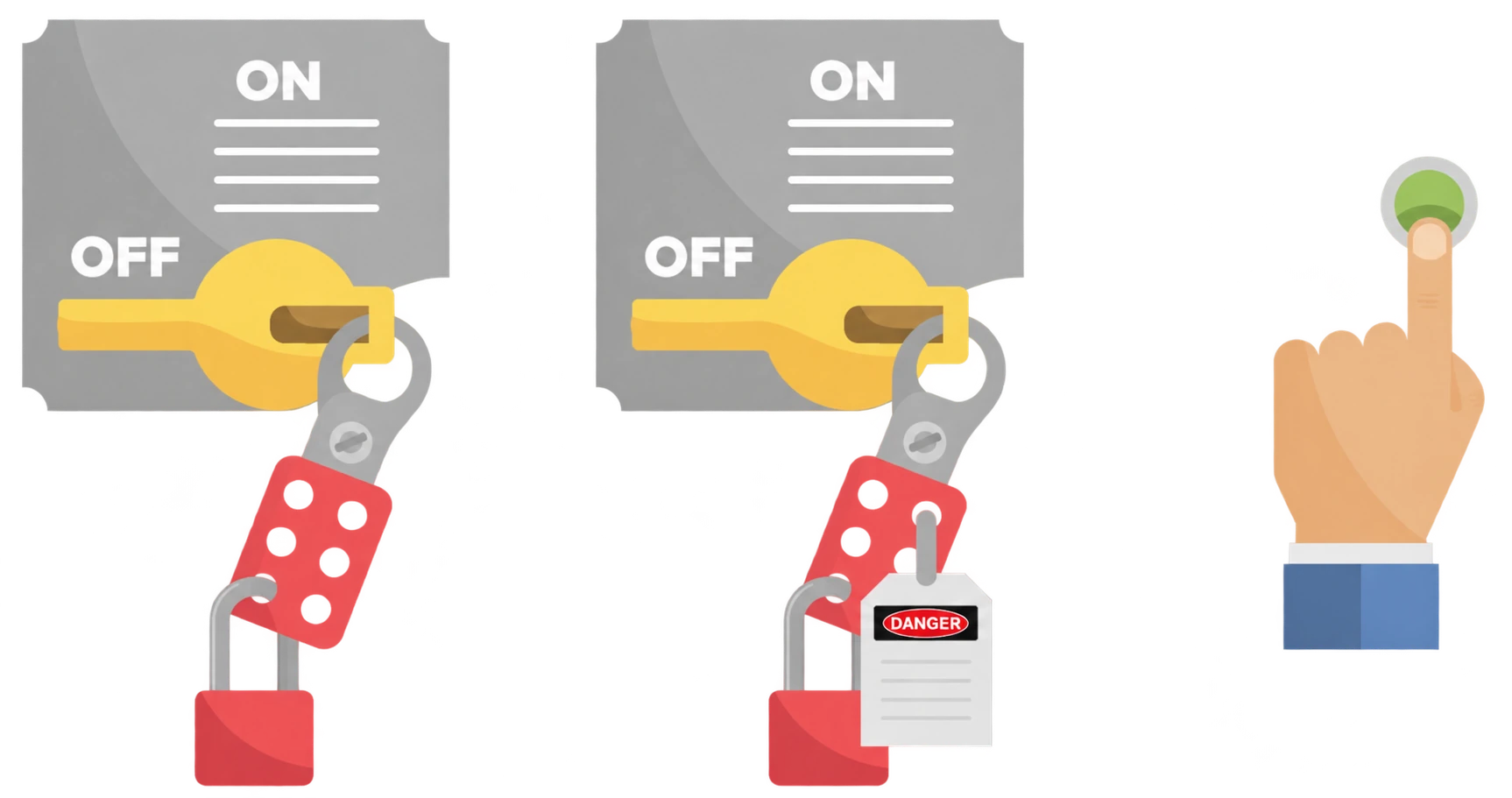 Lockout → Tagout → Tryout
Switching off ≠ isolating
A control panel may stop the process without physically isolating its energy supply. The occupational safety specialist needs to ask where the energy is actually physically isolated.
One worker, one padlock, one key
Each personal LOTO padlock should have a unique key retained by the worker carrying out the maintenance or repair.
A system, not just equipment
An effective LOTOTO programme combines policy, equipment-specific procedures, clearly identified isolation points, training, suitable devices and continual improvement.
When should LOTOTO be applied?
A simple test: if a worker can enter an area, even briefly, where equipment could move, crush, cut, rotate, lift, fall or release pressure, steam, chemicals or electrical energy, a STOP button or a verbal assurance is not enough.
Activities for which hazardous energy control needs to be included in maintenance and servicing arrangements
- maintenance and repair;
- cleaning in hazardous parts of equipment;
- clearing jams, blockages and accumulated material;
- adjustments, setting and component replacement;
- work involving removed guards or open access doors;
- work inside equipment or within the movement area of machine components.
“Only for a moment” is not a control measure
- “Just a quick clean” still places the worker in a danger zone.
- “The operator is nearby and will not restart it” does not replace physical isolation.
- “The emergency stop is pressed” does not necessarily isolate every energy source.
- “Electrical lockout is enough” can leave pressure, inertia, gravity or heat uncontrolled.
Types of hazardous energy
Equipment often has several energy sources. For LOTOTO to work, all relevant sources must be identified, classified and clearly linked to their isolation points.
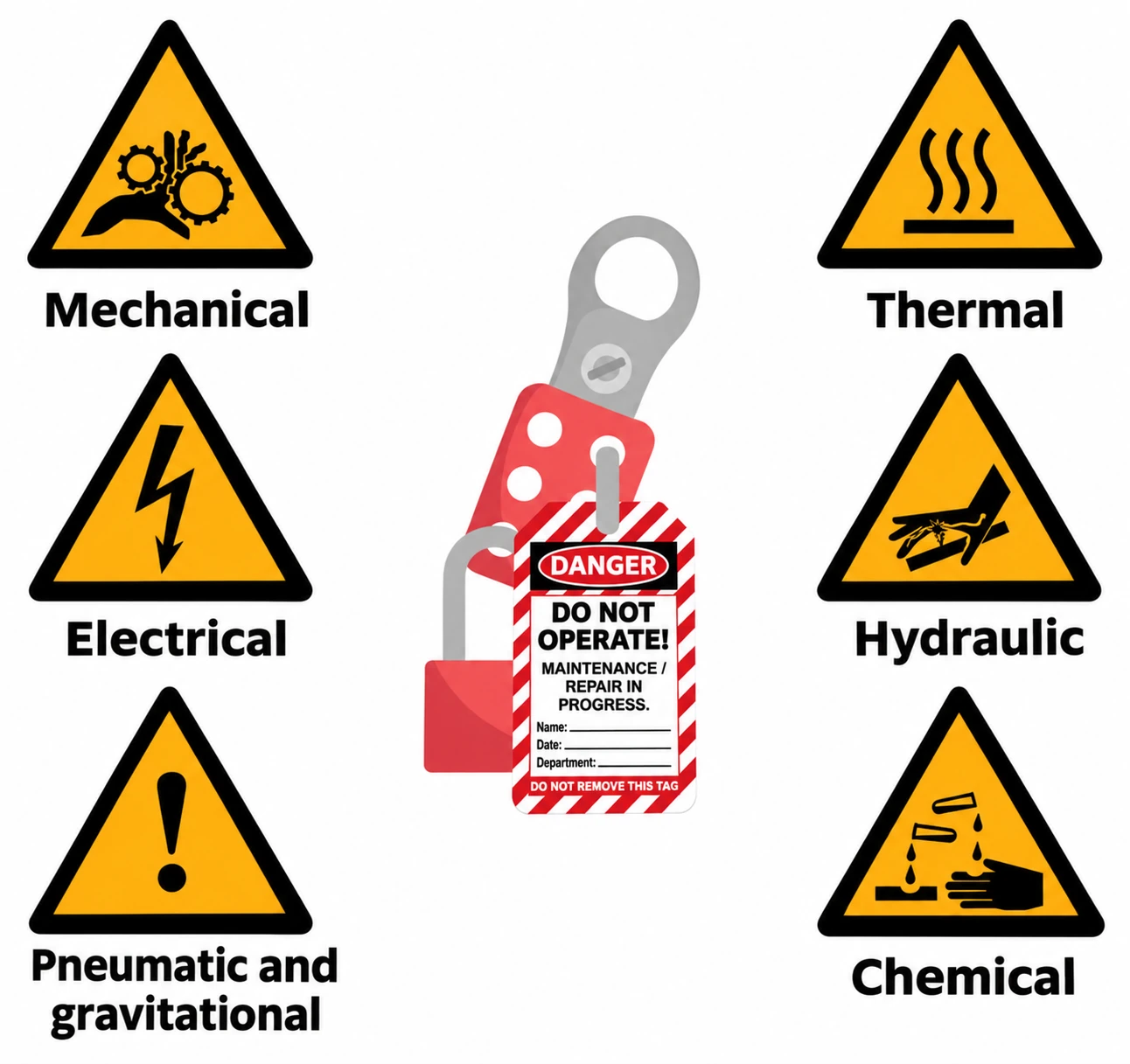
Commonly recognised sources
- Electrical — switchboards, circuit breakers, motors and plugs.
- Mechanical — shafts, chains, belts, blades and drive systems.
- Pneumatic — compressed air, cylinders, valves and hoses.
- Hydraulic — pressurised oil, presses and lifting systems.
Frequently overlooked sources
- Gravitational — raised components, platforms and loads.
- Thermal — steam, hot surfaces and hot materials.
- Chemical — reagents, gases and liquids in pipework.
- Stored energy — springs, capacitors, residual pressure, inertial rotation and fans driven by airflow, among other sources.
A quick energy identification check
- What supplies power to this equipment or makes it move?
- What energy can remain stored after shutdown?
- What could subsequently move, fall, rotate or be released?
- Are there hazards involving liquids, gases, steam, temperature or chemicals?
Have all energy hazards been controlled?
A common mistake is to disconnect electricity while leaving pneumatic pressure, hydraulics or a raised mechanical component uncontrolled. The LOTOTO procedure is complete only when all relevant hazardous energy pathways have been controlled.
The 12-step LOTOTO sequence, with practical explanations
The complete sequence is shown above, followed by the purpose of each step. Occupational safety specialists can use it in training and discussions with maintenance and production teams.
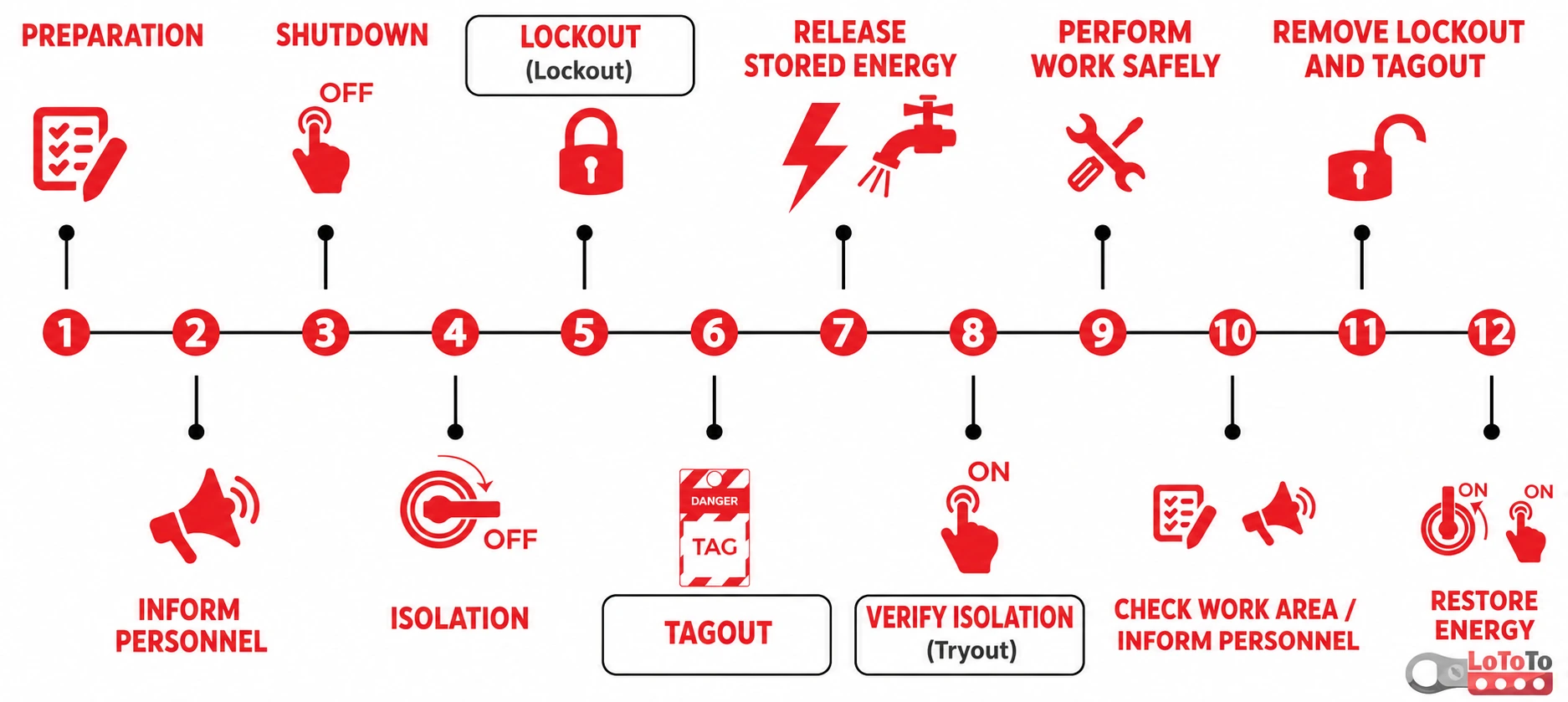
Prepare for the work
Define the task, relevant hazards, people involved and the lockout equipment required.
Inform affected personnel
Notify operators, shift personnel, contractors and other affected people that the equipment will be locked out and temporarily unavailable.
Shut down the equipment normally
Unless there is an emergency, first shut down the equipment using the normal method specified by the manufacturer or the site procedure.
Isolate all energy sources
Isolate electricity, compressed air, hydraulics, steam, gases, liquids, chemicals and any other energy supplies relevant to the task.
Lock out the isolation points
Use suitable padlocks, valve lockouts, cable lockouts or other devices that physically prevent the isolation point from being moved out of its safe position.
Tag the lockout points
Attach a tag to each padlock or lockout point, clearly identifying who applied it, why and for which task.
Release or control stored energy
Release pressure, discharge capacitors, lower or securely support raised parts, restrain moving components and allow inertial movement to stop.
Perform Tryout verification
Verify effective isolation using the checks appropriate to the equipment and task, including controlled attempts to start, pressure checks, measurements and checks for movement.
Carry out the work safely
Begin maintenance, repair or cleaning only after the required locks are in place and effective energy control has been verified.
Prepare the equipment for energy restoration
After completing the work, check that guards have been refitted, tools removed, the area made ready and all personnel are clear of danger zones.
Remove tags and lockout devices
Workers remove their own padlocks and tags under the established procedure. For group LOTOTO, follow the defined handover and confirmation arrangements.
Restore energy and notify personnel
Restore the energy supply in a controlled manner, monitor the initial start-up and notify affected personnel that the equipment has returned to service.
6 steps to an effective company-wide LOTOTO system
The 12 steps relate to an individual task. These six steps help the safety specialist develop a coherent LOTOTO programme across the organisation.
Establish a LOTOTO policy
The written hazardous energy control policy should define programme elements, responsibilities, scope, exceptions and control arrangements.
Prepare equipment-specific procedures
Procedures should be formally documented, clearly linked to the equipment and describe shutdown, isolation, lockout, verification, stored energy control and handover actions.
Identify energy isolation points
Identify valves, switches, circuit breakers, plugs and other isolation points. Their identification must match the procedures and be easy to recognise on site.
Train personnel at every relevant level
Training should address applicable requirements, the company's LOTOTO system, equipment-specific procedures and the actions required of each employee category.
Provide suitable lockout equipment
Select devices after identifying procedures and isolation points. A device that actually fits and secures the isolation point matters more than an attractive kit with no practical application.
Continually improve the programme
Review, audit and update the LOTOTO system after changes, using lessons from maintenance work, incidents and identified deficiencies.
Effective LOTOTO procedures and isolation point identification
Generic wording is not enough. An effective procedure must relate to specific equipment, identifiable points, photographs and a sequence the worker can follow without guesswork.
What should an equipment instruction sheet contain?
How should points be identified?
- number points consistently, for example E-01, P-01, H-01 and G-01;
- use photographs with marked points, not text descriptions alone;
- check that identification on site matches the procedure;
- distinguish control buttons from actual energy isolation devices;
- review points periodically and after modifications.
“Show me where the energy is physically isolated”
If the worker can point only to a control screen or STOP button, but cannot identify the physical disconnect or isolation valve, the system needs further development.
What should you use, and when?
- circuit breaker lockouts for electrical circuits;
- plug lockouts where the energy supply is controlled through a power plug;
- ball or gate valve lockouts for pneumatic, hydraulic, steam or process systems;
- cable lockouts for non-standard points or several handles together;
- group lockout boxes where several workers service the same equipment.
3 employee categories
- Authorised employees — those who apply lockout, verify isolation and carry out the work.
- Affected employees — operators who use the equipment being serviced.
- Other employees — people in the area who need to understand the tags, padlocks and restrictions.
Practical LOTOTO examples by equipment type
These examples help safety specialists connect the principles with actual processes and the questions to ask on site.
A. Conveyor
Hazards: unexpected start-up, entanglement, mechanical movement and blockage clearing.
- isolate the electrical supply at the main isolation point;
- check for additional drives or separate power supplies;
- apply a padlock and tag;
- perform Tryout using the relevant local and central controls.
B. Press
Hazards: hydraulic pressure, falling components and crushing.
- isolate electrical and hydraulic supplies;
- lower or securely support moving components;
- release residual pressure;
- verify that the assembly cannot descend or close.
C. Mixer / mill
Hazards: rotor movement, inertial rotation, residual material and internal cleaning.
- isolate the electrical supply;
- wait until components have stopped completely;
- secure access points and apply the site's permit-to-work arrangements where required;
- perform Tryout and visual checks before entry.
D. Compressed air system
Hazards: cylinder movement, hose whip and residual pressure.
- close the air supply valve;
- secure the valve with a suitable lockout device;
- release pressure and check the pressure gauge;
- verify that cylinders cannot move.
E. Chemical pipework
Hazards: leakage, pressure, temperature and incorrect valve positions.
- isolate valves and use positive isolation such as blanking where required;
- depressurise and drain residual material to a safe collection point;
- assess temperature and chemical exposure hazards;
- clearly identify the work being carried out and substances that may remain in the system.
F. Several workers on one machine
Hazards: the mistaken assumption that one person is responsible for everyone.
- use a group lockout box or another arrangement that gives each worker personal control;
- each worker applies their own padlock;
- each worker removes their padlock after completing their part of the work;
- manage shift handovers through a clearly defined procedure.
Common mistakes that weaken LOTOTO
This list is useful for internal audits, site inspections ( walk-throughs) and quick reviews at the workplace.
Common gaps in practice
- relying only on a STOP button or an HMI command;
- applying a tag without a padlock;
- locking a point that does not actually isolate the relevant energy;
- leaving stored energy uncontrolled;
- omitting Tryout verification;
- using one personal padlock for several workers;
- leaving a key in a shared location or handing it to a colleague;
- using a procedure that no longer matches modified equipment;
- having no photographs, clear reference numbers or identification on site;
- excluding contractors from the LOTOTO arrangements;
- restarting equipment without checking the work area;
- applying LOTOTO inconsistently, only when someone remembers.
A basic company LOTOTO programme package
- LOTOTO policy and assigned responsibilities;
- equipment-specific procedures;
- a register and photographs of energy isolation points;
- arrangements for managing LOTO devices and padlocks;
- employee training records;
- group LOTOTO arrangements;
- periodic inspection and audit records;
- a register of deficiencies and corrective actions.
Self-check questionnaire for occupational safety specialists
Tick “yes” where the statement broadly reflects actual practice in your company. More “yes” answers indicate a more developed LOTOTO programme.
Section 1. Policy and responsibilities
Has LOTOTO been established as a coherent programme?
Section 2. Equipment and energy sources
Do you know what needs isolating, and from which energy sources?
Section 3. Procedures
Can the worker understand what to do, step by step?
Section 4. Equipment
Is everything needed for effective lockout available on site?
Section 5. Training and behaviour
Do workers know how to apply LOTOTO in practice?
Section 6. Review and improvement
Is the programme reviewed, and does it work in practice?
Need help implementing LOTOTO?
Sauga pro can help develop the policy and equipment procedures, identify isolation points, select suitable devices and provide practical employee training.
